
Benchtop · Sydney
Marble benchtops, restored on the bench.
Etching, dull rings, fine scratching along the working edge, a chip on the front. Nearly all of it comes out in place, in a day, without lifting the top.
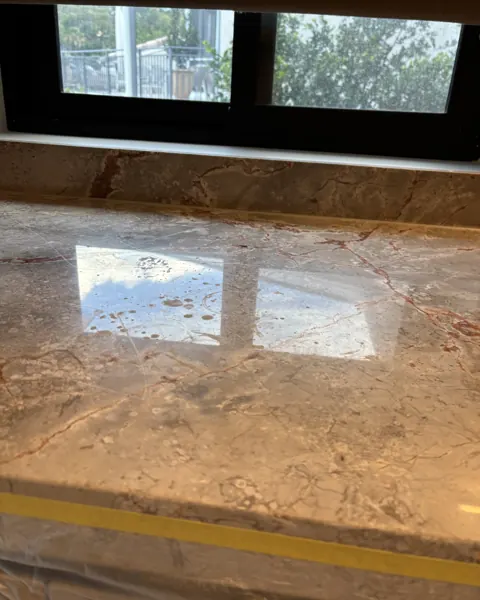
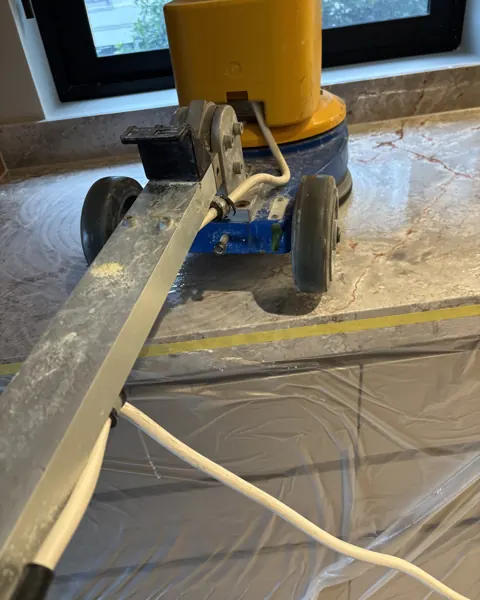
What we do to a benchtop.
A kitchen benchtop is the most used stone in the house and the first to show it. Lemon, wine, vinegar and most supermarket sprays etch marble on contact. Chopping and wiping in one direction leave hairline scratches that read as a dull patch under the pendant light. None of that is structural. It is a thin damaged layer sitting on sound stone, and it comes off.
- Etch marks and dull rings honed out and re-polished
- Fine scratching along the working edge removed
- Chips on the front edge filled, shaped and colour-matched
- Whole-top re-polish so a repair reads as part of the surface
- Sealed and cured before you cook on it again
The price shape.
Method first, then the band. Every figure on this site comes from invoices, never from a guess.
Benchtop restoration
Most benchtops are one visit. A heavily etched island or a top with edge repairs can run into a second morning.
4 documented benchtop jobs.
Shot as found and as left, from the same spot. What could not be fixed is on every record.
A tan marble benchtop, brought back with a test patch first
Tan veined marble · Benchtop · Apr 2025
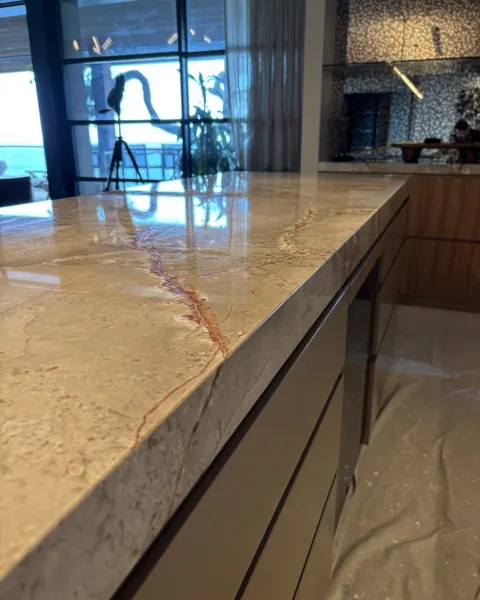
A grey marble island, polished back to a reflection
Grey marble · Benchtop · Apr 2025
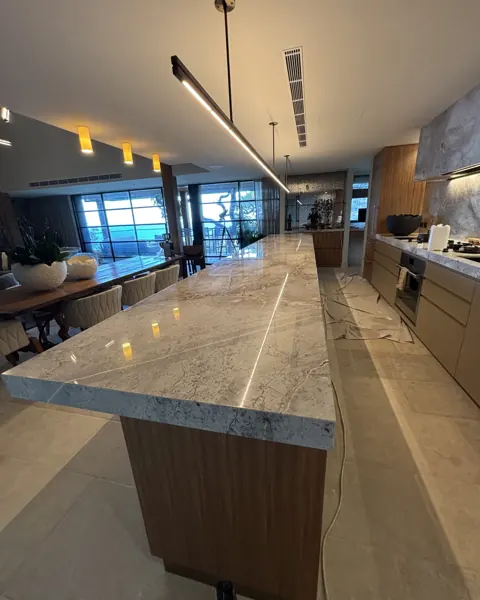
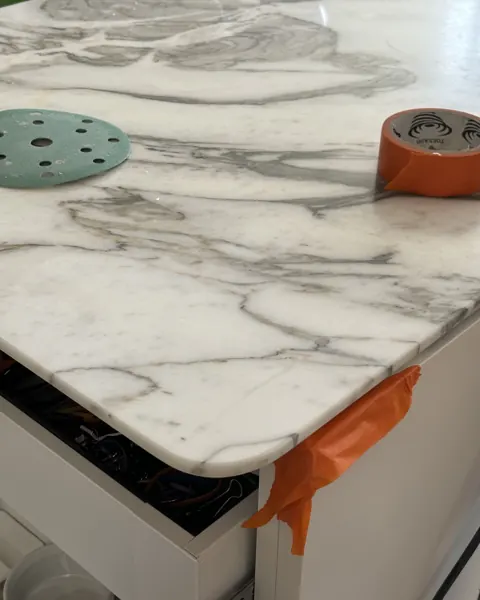
A white marble benchtop with an edge repair
White marble with grey veining · Benchtop · Jan 2025
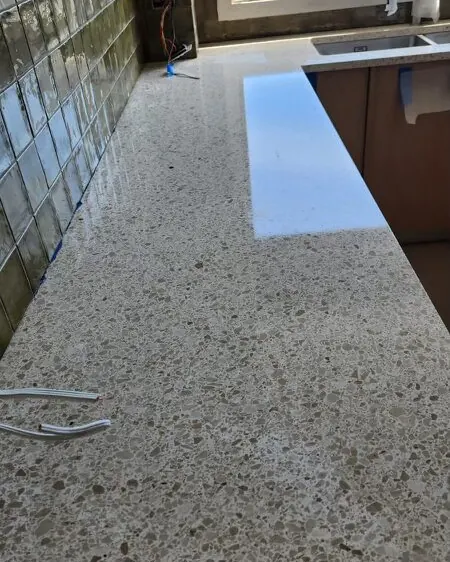
A speckled stone benchtop, cleaned and polished under a mirror splashback
Speckled stone · Benchtop · Date to confirm
Questions about benchtops
Can etched marble be restored, or does it need replacing?
Etched marble can be restored in place, and replacement is almost never the right answer. Etching is a thin layer of the polished surface dissolved by acid. It is not a stain and it does not go deep. The mark is honed off with diamond abrasives and the area is re-polished to match the rest of the top. On a benchtop that is usually a couple of hours of work, done on the bench with the kitchen protected. Deep etching that has left a visible dip takes more honing and blends less perfectly, and that is exactly the sort of case we cut a test patch for before committing. Replacing a benchtop means a new slab, templating, fabrication, removal, plumbing and a splashback, and weeks without a kitchen. Restoring it is a fraction of that.
How soon can I use my benchtop after it is restored?
The same evening for most jobs. The polishing itself leaves the surface ready to use immediately. What needs time is the sealer, which is applied last and needs to cure before the stone is exposed to water and oil. For most penetrating sealers that is a few hours to overnight, and we tell you the exact window before we leave. Light use, like putting the kettle on, is fine straight away. Chopping, spills and hot pans should wait until the sealer has cured. We leave a short care card on the bench with the cleaners that are safe on sealed stone and the ones that will undo the work.
Will a chip repair be invisible?
On a plain stone, close to it. On a heavily veined marble, no, and we would rather say so than surprise you. A chip is filled with a colour-matched resin, shaped to the edge profile and polished with the surrounding stone, so it is smooth, durable and the right colour. What it cannot do is reproduce the veining running through it, so on a stone like Carrara or Arabescato the repair reads as a small plain patch from close up. From standing height it disappears. We show you the result on the first repair before doing the rest, and if the visibility bothers you there are alternatives, including a small edge profile change that removes the chip rather than filling it.
Is it cheaper to replace a marble benchtop than restore it?
No. Restoring a marble benchtop costs a fraction of replacing it, and the gap is wider than most people expect. Replacement means a new slab, a template, fabrication, removal of the old top, a plumber to disconnect and reconnect the sink, a new splashback if the old one was bonded, and typically two to four weeks without a working kitchen. Restoration is one visit, done in place, with the kitchen protected and back in use that evening. The only time replacement makes sense is when the stone itself has failed structurally, which is rare. Our pricing page shows the restoration bands beside typical replacement figures so you can see the gap for yourself.
Do you work on engineered stone or Caesarstone?
Some of it. Engineered stone is a resin and quartz product, and it behaves differently from natural marble. It does not etch, but it does scratch and it can be burnt by hot pans, and both of those can usually be improved in place. What it cannot be is polished the way marble is, because the resin does not respond to the same abrasives. From July 2024, engineered stone has been banned from new installation in Australia; work on legacy benchtops already in homes is permitted under strict dust controls, and we only take it on where we can meet them. If you are unsure whether your top is natural or engineered, send a photo. We can usually tell.
What is wrong with it
Other surfaces
Send a photo of the benchtop.
Two or three photos, your suburb, and what is bothering you. Most benchtop, vanity and table quotes come back the same day.
